The 10-Year Healthcare Budget: A Practical Plan Boomers Can Actually Follow
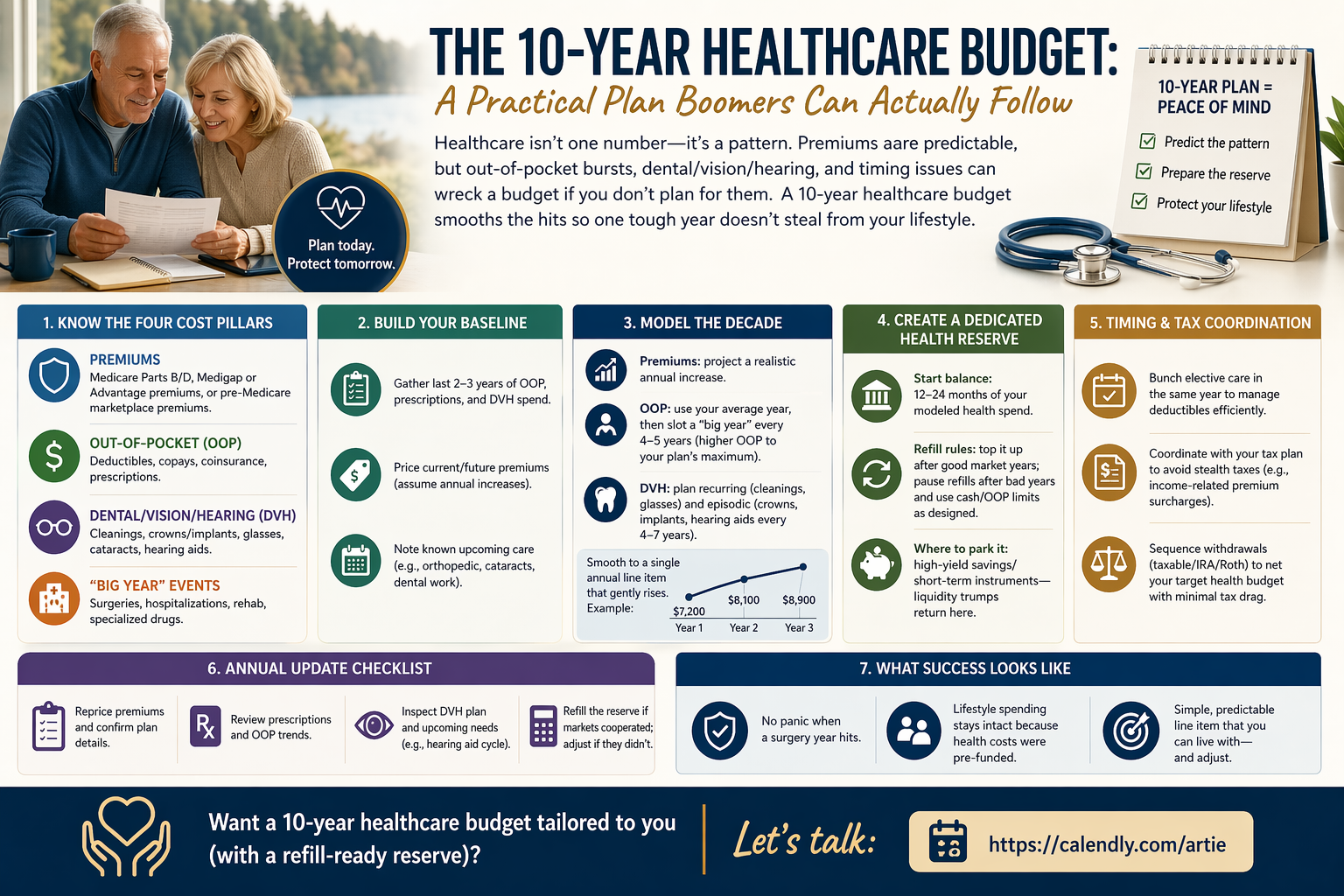
Healthcare isn’t one number—it’s a pattern. Premiums are predictable, but out-of-pocket bursts, dental/vision/hearing, and timing issues can wreck a budget if you don’t plan for them. A 10-year healthcare budget smooths the hits so one tough year doesn’t steal from your lifestyle.
Part 1: Know the four cost pillars
- Premiums: Medicare Parts B/D, Medigap or Advantage premiums, or pre-Medicare marketplace premiums.
- Out-of-pocket (OOP): deductibles, copays, coinsurance, prescriptions.
- Dental/vision/hearing (DVH): cleanings, crowns/implants, glasses, cataracts, hearing aids.
- “Big year” events: surgeries, hospitalizations, rehab, specialized drugs.
Part 2: Build your baseline
- Gather last 2–3 years of OOP, prescriptions, and DVH spend.
- Price current/future premiums (assume annual increases).
- Note known upcoming care (e.g., orthopedic, cataracts, dental work).
Part 3: Model the decade
- Premiums: project a realistic annual increase.
- OOP: use your average year, then slot a “big year” every 4–5 years (higher OOP to your plan’s maximum).
- DVH: plan recurring (cleanings, glasses) and episodic (crowns, implants, hearing aids every 4–7 years).
- Smooth to a single annual line item that gently rises. Example: $7,200 → $8,100 → $8,900 over 3 years.
Part 4: Create a dedicated health reserve
- Start balance: 12–24 months of your modeled health spend.
- Refill rules: top it up after good market years; pause refills after bad years and use cash/OOP limits as designed.
- Where to park it: high-yield savings/short-term instruments—liquidity trumps return here.
Part 5: Timing and tax coordination
- Bunch elective care in the same year to manage deductibles efficiently.
- Coordinate with your tax plan to avoid stealth taxes (e.g., income-related premium surcharges).
- Sequence withdrawals (taxable/IRA/Roth) to net your target health budget with minimal tax drag.
Part 6: Annual update checklist
- Reprice premiums and confirm plan details.
- Review prescriptions and OOP trends.
- Inspect DVH plan and upcoming needs (e.g., hearing aid cycle).
- Refill the reserve if markets cooperated; adjust if they didn’t.
Part 7: What success looks like
- No panic when a surgery year hits.
- Lifestyle spending stays intact because health costs were pre-funded.
- Simple, predictable line item that you can live with—and adjust.
CTA: Want a 10-year healthcare budget tailored to you (with a refill-ready reserve)?
Let’s talk: https://calendly.com/artie